
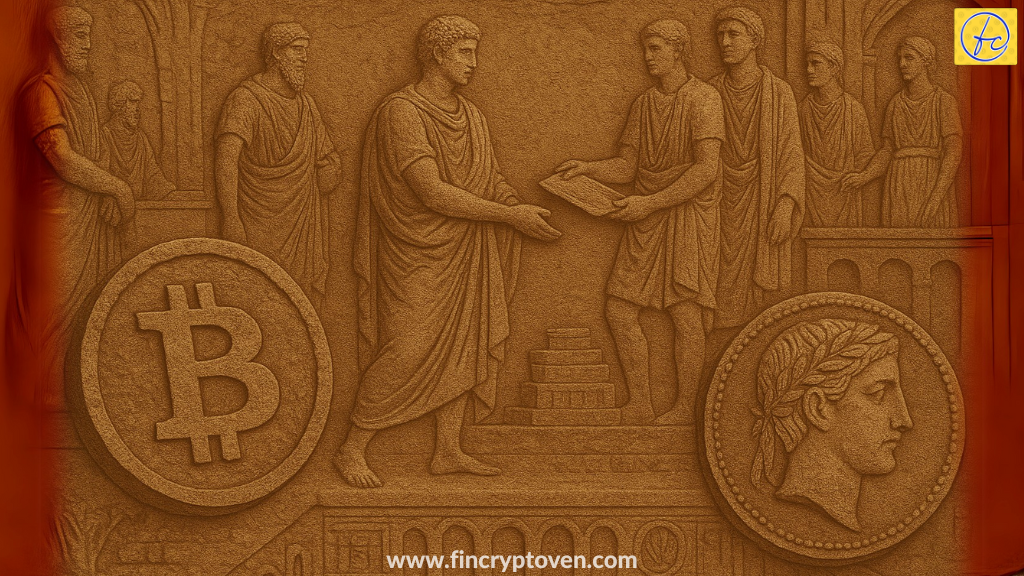
What If Crypto Was Invented in Ancient Times? (Goal Completion ✅)
What if crypto was invented in ancient times? This question sparks curiosity, imagination, and a deep rethinking of how civilizations might have evolved. From Roman tax ledgers to Egyptian pyramid payrolls, this blog unpacks every angle of this wild but insightful thought experiment. By the end, you won’t need to read another blog to satisfy your curiosity.
Before Time Travel: What Is Crypto, Really?
To explore what if crypto was invented in ancient times, we need to understand crypto first:
- Cryptocurrency is a secure, digital currency built on blockchain—a distributed, immutable ledger.
- It removes the need for intermediaries like banks and enables peer-to-peer trustless transactions.
- The first real crypto—Bitcoin—was introduced in 2009. But what if something similar existed during the Pharaohs’ reign or the Roman Empire?
Let’s explore 7 wild truths of what if crypto was invented in ancient times.
1. Ancient Rome: Taxation Through Digital Denarii?
Imagine a Roman citizen logging into a blockchain ledger to pay taxes using a digital Denarius. If you’re wondering what if crypto was invented in ancient times, Rome would likely be an early adopter.
- Smart contracts could automate soldier pensions or public building funds.
- Transparency would eliminate corruption by regional governors.
Example: A gladiator signs a smart contract for prize money, executed only if he survives the arena—no need for middlemen.
2. Crypto on the Silk Road: Decentralized Commerce
One of the most exciting answers to what if crypto was invented in ancient times comes from the Silk Road trade network.
- Traders moving between China, India, Persia, and Europe faced currency conversion and fraud.
- Crypto would allow trustless, borderless trade with digital wallets.
- Blockchain could verify the origin and authenticity of goods.
Example: A Chinese silk merchant sends shipment info to a Persian buyer, who unlocks crypto payment once delivery is confirmed—no need for language or legal intermediaries.
3. Egypt: Blockchain Before Papyrus?
If you’ve ever thought about what if crypto was invented in ancient times, Egypt is a perfect testbed.
- Ancient Egyptians already recorded transactions on papyrus.
- Blockchain would revolutionize the temple economy, tracking grain, gold, and labor tokens.
Fun idea: Pyramid construction workers receive daily wages in bread and beer tokens—recorded permanently on a stone or symbolic ledger.
4. Maurya Empire: Chanakya’s Digital Arthashastra?
Economist Chanakya may have penned the earliest form of economic governance in the Arthashastra. Now imagine what if crypto was invented in ancient times—he might have coded smart contracts.
- Janapada Coins could be decentralized local currencies.
- Blockchain used for land revenue, military budgeting, and administrative transparency.
Example: Border tax paid via crypto could trigger automated funding for frontier defense.
5. Greek Democracy: Transparent Voting Systems
Another powerful idea in the discussion of what if crypto was invented in ancient times is transparent voting in Greek city-states.
- Blockchain-enabled voting would stop electoral fraud.
- Smart contracts could auto-enact policies based on vote counts.
Example: Citizens of Athens vote on naval funding via token, verified on public ledgers—no tampering possible.
What If Crypto Was Invented in Ancient Times: Would Civilization Be Different?
Definitely. Let’s explore how society might evolve differently:
Benefits
- Reduced corruption: Transparent ledgers would expose misuse of funds.
- Efficient governance: Automation in public works and pensions.
- Trade standardization: No currency exchange or forged coins.
- Empowered citizens: Peer-to-peer systems without kings or banks.
But Wait…
There are key barriers in imagining what if crypto was invented in ancient times:
- No electricity or internet: The core of blockchain tech.
- Zero computing power: No mining or cryptographic functions.
- Elite monopolization: Likely only priests or emperors could use it.
- Low literacy rates: Public adoption would be near impossible.
Conclusion: Crypto might exist but be centralized and elite-controlled—not liberating.
Ancient Blockchain Infrastructure – Could It Exist?
Here’s a fictional but plausible infrastructure if you’re still wondering what if crypto was invented in ancient times:
| Component | Ancient Equivalent |
|---|---|
| Ledger | Stone tablets, clay seals, copper sheets |
| Verification Nodes | Priests, scribes, or astrologers |
| Token | Grains, gold, land-use credits |
| Encryption | Sacred symbols, hidden languages |
| Consensus | Tribal council, royal decree |
This would resemble a proto-blockchain—low-tech, slow, but trust-based and public.
Rewriting History: What If Crypto Was Invented in Ancient Times?
Looking at how crypto could have reshaped history:
- No central banks today—if crypto dominated early.
- Blockchain religions—texts immutably stored and verified.
- Smart property laws—inheritance and land ownership coded forever.
- War funding—nations could crowdsource wars transparently.
5 FAQs About What If Crypto Was Invented in Ancient Times
Q1: Could crypto exist in ancient times without tech?
A: Not in its modern form. But crypto-like systems could exist using tokens, symbols, and manual ledgers.
Q2: Would early civilizations understand blockchain concepts?
A: Yes, indirectly—concepts like ledgers, contracts, and trust systems already existed.
Q3: Which civilization was best prepared for crypto?
A: Ancient Egypt or Rome—thanks to strong record-keeping and centralized administration.
Q4: Would crypto make ancient societies more equal?
A: Unlikely. Without universal access, it would mostly benefit the elite or ruling class.
Q5: Could smart contracts work in ancient courts?
A: Yes, via symbolic codes and agreements enforced by scribes or religious authorities.
Final Word on What If Crypto Was Invented in Ancient Times
As wild as it seems, exploring what if crypto was invented in ancient times opens the door to fresh perspectives on both technology and history. Though practically unfeasible in their era, the principles of decentralization, transparency, and automation could have changed the game for empires. And if nothing else, it shows us how futuristic crypto really is—and how deeply ancient societies yearned for trust, accountability, and better systems.
DISCLAIMER
The views, thoughts, and opinions expressed in this article belong solely to the author, and should not be taken as investment advice. Do your own research before taking any investment decisions.

